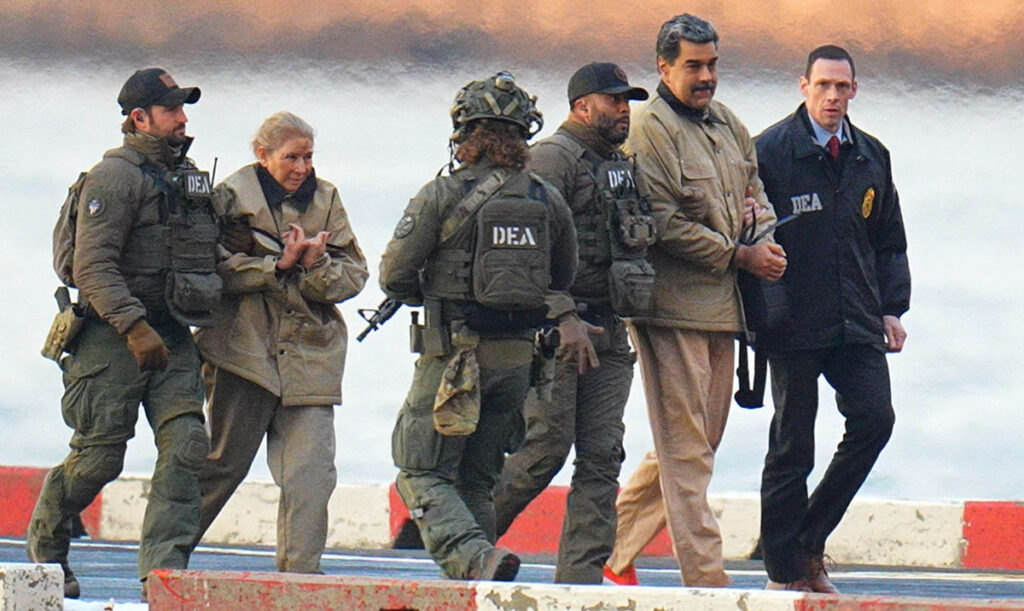
Venezuelan President Nicolás Maduro appeared in a Manhattan federal courtroom Monday for his first court appearance after being taken into U.S. custody over the weekend on sweeping drug trafficking charges. His wife, Cilia Flores, was also brought to New York and is expected to make her own court appearance later the same day.
During the brief hearing, Maduro entered a not guilty plea to all charges. Speaking through an interpreter, he told the court, “I’m innocent. I’m not guilty — I’m a decent man,” adding that he is “still president of my country.”
RELATED: WATCH: Nicolás Maduro and Wife Cilia Flores Taken to Manhattan Court on Drug Trafficking Charges
Prosecutors say Maduro is facing some of the most serious federal charges on the books, including narco-terrorism and conspiracy to traffic cocaine into the United States. If convicted, he could spend the rest of his life in prison.
Earlier Monday, video and photos showed Maduro being escorted from a helicopter in Manhattan under heavy security, surrounded by armed Drug Enforcement Administration agents. His arrival marked the first time a sitting foreign head of state has been brought before a U.S. court on drug trafficking charges.
Flores was taken into custody during a pre-dawn raid in Caracas on Saturday. Federal authorities say she is charged alongside her husband in the alleged criminal conspiracy and will have the opportunity to enter her plea during her own court appearance.
According to the unsealed indictment, the case goes beyond drug trafficking. Prosecutors also accuse Maduro and Flores of conspiracy to possess machine guns and destructive devices, alleging the weapons were intended to be used against U.S. interests.
Federal officials allege the charges reflect years of criminal activity tied to Venezuela’s highest levels of power, describing what they call a blurred line between government leadership and organized crime.
The arrests have sparked immediate international backlash. Several countries have condemned the operation, accusing the United States of violating Venezuela’s sovereignty. U.S. officials maintain the operation was carefully planned over several months and executed with coordination across multiple agencies.
Maduro rose to power in 2013 following the death of Hugo Chávez, inheriting a country heavily dependent on oil revenues just as global prices collapsed. The years that followed were marked by economic turmoil, shortages, and mass migration.
In Caracas, Vice President Delcy Rodríguez denounced the arrests, calling them a “kidnapping” and demanding Maduro’s immediate release.
For now, however, the longtime Venezuelan leader remains in federal custody in New York, awaiting the next steps in a case that could take months, if not years, to reach trial.